 Add to Chrome
 Add to Firefox
 Add to Edge
Doing What They Say, Not What They Reason: Locating the Faithfulness Gap in LLM Agents
May 30, 2026
Do LLM agents act on the reasoning they state? This question of process fidelity is central to using LLMs in social simulation, yet it is hard to measure where no reference for correct behavior exists. We study it in acontrolled setting, a Texas Poker simulator with a verifiable reference action for every decision by decomposing the faithfulness gap into two steps: reasoning-conclusion and conclusion-action. The two steps behave oppositely.

SWE-Mutation: Can LLMs Generate Reliable Test Suites in Software Engineering?
May 21, 2026Evaluating software engineering capabilities has become a core component of modern large language models (LLMs); however, the key bottleneck hindering further scaling lies not in the scarcity of high-quality solutions, but in the lack of high-quality test suites. Test suites are indispensable both for synthesizing program repair trajectories and for providing precise feedback signals in reinforcement learning. Unfortunately, due to the high cost and difficulty of annotation, high-quality test suites have long been hard to obtain, while those automatically generated by LLMs tend to be superficial and lack sufficient discriminative power. As a first step toward constructing high-quality test suites, we introduce SWE-Mutation, a benchmark for evaluating LLM-generated test suites. The benchmark characterizes test suites by introducing systematically mutated solutions that attempt to ``fool'' the test suites and pass validation. We further propose an agentic, language-agnostic framework for automatically generating complex mutants. Our benchmark consists of 2,636 mutated variants derived from 800 original instances and includes a multilingual subset spanning nine programming languages. Experiments on seven LLMs reveal that even DeepSeek-V3.1 achieves only 10.20% verification and 36.15% detection rates, highlighting the inadequacy of current LLMs. Additionally, our agentic mutation strategy enhances realism, reducing average detection rates from 71.04% to 39.81% compared to conventional methods. These findings expose persistent deficiencies in the ability of current LLMs to generate reliable and discriminative test suites.
* 24 pages, 8 figures
Dropping Anchor and Spherical Harmonics for Sparse-view Gaussian Splatting
Feb 24, 2026Recent 3D Gaussian Splatting (3DGS) Dropout methods address overfitting under sparse-view conditions by randomly nullifying Gaussian opacities. However, we identify a neighbor compensation effect in these approaches: dropped Gaussians are often compensated by their neighbors, weakening the intended regularization. Moreover, these methods overlook the contribution of high-degree spherical harmonic coefficients (SH) to overfitting. To address these issues, we propose DropAnSH-GS, a novel anchor-based Dropout strategy. Rather than dropping Gaussians independently, our method randomly selects certain Gaussians as anchors and simultaneously removes their spatial neighbors. This effectively disrupts local redundancies near anchors and encourages the model to learn more robust, globally informed representations. Furthermore, we extend the Dropout to color attributes by randomly dropping higher-degree SH to concentrate appearance information in lower-degree SH. This strategy further mitigates overfitting and enables flexible post-training model compression via SH truncation. Experimental results demonstrate that DropAnSH-GS substantially outperforms existing Dropout methods with negligible computational overhead, and can be readily integrated into various 3DGS variants to enhance their performances. Project Website: https://sk-fun.fun/DropAnSH-GS
How Do We Research Human-Robot Interaction in the Age of Large Language Models? A Systematic Review
Feb 13, 2026Advances in large language models (LLMs) are profoundly reshaping the field of human-robot interaction (HRI). While prior work has highlighted the technical potential of LLMs, few studies have systematically examined their human-centered impact (e.g., human-oriented understanding, user modeling, and levels of autonomy), making it difficult to consolidate emerging challenges in LLM-driven HRI systems. Therefore, we conducted a systematic literature search following the PRISMA guideline, identifying 86 articles that met our inclusion criteria. Our findings reveal that: (1) LLMs are transforming the fundamentals of HRI by reshaping how robots sense context, generate socially grounded interactions, and maintain continuous alignment with human needs in embodied settings; and (2) current research is largely exploratory, with different studies focusing on different facets of LLM-driven HRI, resulting in wide-ranging choices of experimental setups, study methods, and evaluation metrics. Finally, we identify key design considerations and challenges, offering a coherent overview and guidelines for future research at the intersection of LLMs and HRI.
WaterClear-GS: Optical-Aware Gaussian Splatting for Underwater Reconstruction and Restoration
Jan 27, 2026Underwater 3D reconstruction and appearance restoration are hindered by the complex optical properties of water, such as wavelength-dependent attenuation and scattering. Existing Neural Radiance Fields (NeRF)-based methods struggle with slow rendering speeds and suboptimal color restoration, while 3D Gaussian Splatting (3DGS) inherently lacks the capability to model complex volumetric scattering effects. To address these issues, we introduce WaterClear-GS, the first pure 3DGS-based framework that explicitly integrates underwater optical properties of local attenuation and scattering into Gaussian primitives, eliminating the need for an auxiliary medium network. Our method employs a dual-branch optimization strategy to ensure underwater photometric consistency while naturally recovering water-free appearances. This strategy is enhanced by depth-guided geometry regularization and perception-driven image loss, together with exposure constraints, spatially-adaptive regularization, and physically guided spectral regularization, which collectively enforce local 3D coherence and maintain natural visual perception. Experiments on standard benchmarks and our newly collected dataset demonstrate that WaterClear-GS achieves outstanding performance on both novel view synthesis (NVS) and underwater image restoration (UIR) tasks, while maintaining real-time rendering. The code will be available at https://buaaxrzhang.github.io/WaterClear-GS/.
Beyond Model Scaling: Test-Time Intervention for Efficient Deep Reasoning
Jan 16, 2026Large Reasoning Models (LRMs) excel at multi-step reasoning but often suffer from inefficient reasoning processes like overthinking and overshoot, where excessive or misdirected reasoning increases computational cost and degrades performance. Existing efficient reasoning methods operate in a closed-loop manner, lacking mechanisms for external intervention to guide the reasoning process. To address this, we propose Think-with-Me, a novel test-time interactive reasoning paradigm that introduces external feedback intervention into the reasoning process. Our key insights are that transitional conjunctions serve as natural points for intervention, signaling phases of self-validation or exploration and using transitional words appropriately to prolong the reasoning enhances performance, while excessive use affects performance. Building on these insights, Think-with-Me pauses reasoning at these points for external feedback, adaptively extending or terminating reasoning to reduce redundancy while preserving accuracy. The feedback is generated via a multi-criteria evaluation (rationality and completeness) and comes from either human or LLM proxies. We train the target model using Group Relative Policy Optimization (GRPO) to adapt to this interactive mode. Experiments show that Think-with-Me achieves a superior balance between accuracy and reasoning length under limited context windows. On AIME24, Think-with-Me outperforms QwQ-32B by 7.19% in accuracy while reducing average reasoning length by 81% under an 8K window. The paradigm also benefits security and creative tasks.
How well can off-the-shelf LLMs elucidate molecular structures from mass spectra using chain-of-thought reasoning?
Jan 09, 2026Mass spectrometry (MS) is a powerful analytical technique for identifying small molecules, yet determining complete molecular structures directly from tandem mass spectra (MS/MS) remains a long-standing challenge due to complex fragmentation patterns and the vast diversity of chemical space. Recent progress in large language models (LLMs) has shown promise for reasoning-intensive scientific tasks, but their capability for chemical interpretation is still unclear. In this work, we introduce a Chain-of-Thought (CoT) prompting framework and benchmark that evaluate how LLMs reason about mass spectral data to predict molecular structures. We formalize expert chemists' reasoning steps-such as double bond equivalent (DBE) analysis, neutral loss identification, and fragment assembly-into structured prompts and assess multiple state-of-the-art LLMs (Claude-3.5-Sonnet, GPT-4o-mini, and Llama-3 series) in a zero-shot setting using the MassSpecGym dataset. Our evaluation across metrics of SMILES validity, formula consistency, and structural similarity reveals that while LLMs can produce syntactically valid and partially plausible structures, they fail to achieve chemical accuracy or link reasoning to correct molecular predictions. These findings highlight both the interpretive potential and the current limitations of LLM-based reasoning for molecular elucidation, providing a foundation for future work that combines domain knowledge and reinforcement learning to achieve chemically grounded AI reasoning.
Beyond Fast and Slow: Cognitive-Inspired Elastic Reasoning for Large Language Models
Dec 17, 2025Large language models (LLMs) have demonstrated impressive performance across various language tasks. However, existing LLM reasoning strategies mainly rely on the LLM itself with fast or slow mode (like o1 thinking) and thus struggle to balance reasoning efficiency and accuracy across queries of varying difficulties. In this paper, we propose Cognitive-Inspired Elastic Reasoning (CogER), a framework inspired by human hierarchical reasoning that dynamically selects the most suitable reasoning strategy for each query. Specifically, CogER first assesses the complexity of incoming queries and assigns them to one of several predefined levels, each corresponding to a tailored processing strategy, thereby addressing the challenge of unobservable query difficulty. To achieve automatic strategy selection, we model the process as a Markov Decision Process and train a CogER-Agent using reinforcement learning. The agent is guided by a reward function that balances solution quality and computational cost, ensuring resource-efficient reasoning. Moreover, for queries requiring external tools, we introduce Cognitive Tool-Assisted Reasoning, which enables the LLM to autonomously invoke external tools within its chain-of-thought. Extensive experiments demonstrate that CogER outperforms state-of-the-art Test-Time scaling methods, achieving at least a 13% relative improvement in average exact match on In-Domain tasks and an 8% relative gain on Out-of-Domain tasks.
TARG: Training-Free Adaptive Retrieval Gating for Efficient RAG
Nov 12, 2025Retrieval-Augmented Generation (RAG) improves factuality but retrieving for every query often hurts quality while inflating tokens and latency. We propose Training-free Adaptive Retrieval Gating (TARG), a single-shot policy that decides when to retrieve using only a short, no-context draft from the base model. From the draft's prefix logits, TARG computes lightweight uncertainty scores: mean token entropy, a margin signal derived from the top-1/top-2 logit gap via a monotone link, or small-N variance across a handful of stochastic prefixes, and triggers retrieval only when the score exceeds a threshold. The gate is model agnostic, adds only tens to hundreds of draft tokens, and requires no additional training or auxiliary heads. On NQ-Open, TriviaQA, and PopQA, TARG consistently shifts the accuracy-efficiency frontier: compared with Always-RAG, TARG matches or improves EM/F1 while reducing retrieval by 70-90% and cutting end-to-end latency, and it remains close to Never-RAG in overhead. A central empirical finding is that under modern instruction-tuned LLMs the margin signal is a robust default (entropy compresses as backbones sharpen), with small-N variance offering a conservative, budget-first alternative. We provide ablations over gate type and prefix length and use a delta-latency view to make budget trade-offs explicit.
ComoRAG: A Cognitive-Inspired Memory-Organized RAG for Stateful Long Narrative Reasoning
Aug 14, 2025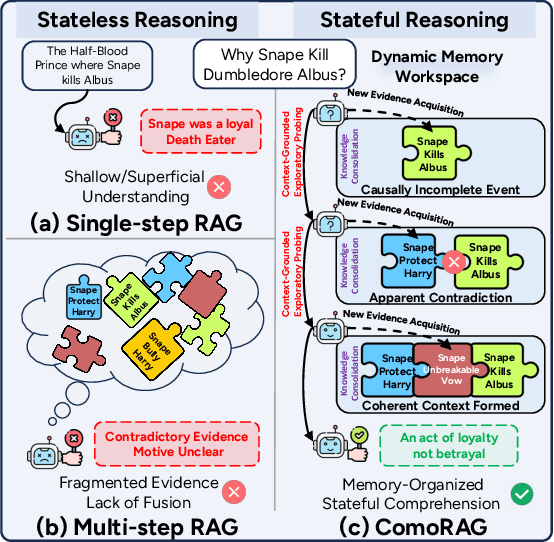
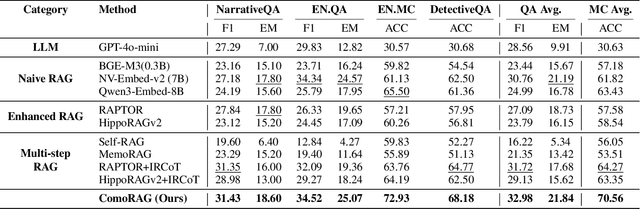
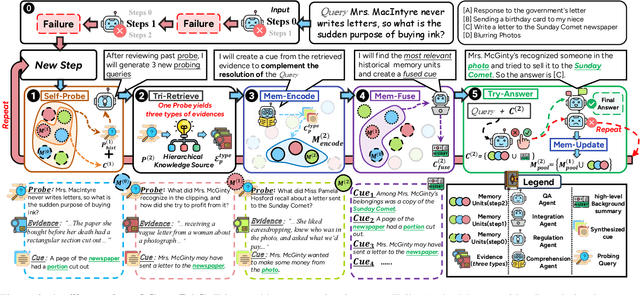
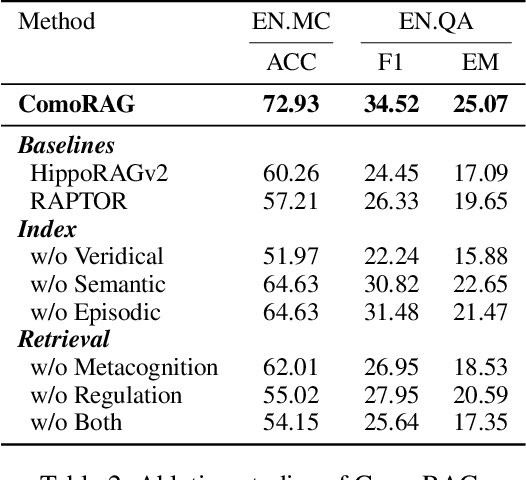
Narrative comprehension on long stories and novels has been a challenging domain attributed to their intricate plotlines and entangled, often evolving relations among characters and entities. Given the LLM's diminished reasoning over extended context and high computational cost, retrieval-based approaches remain a pivotal role in practice. However, traditional RAG methods can fall short due to their stateless, single-step retrieval process, which often overlooks the dynamic nature of capturing interconnected relations within long-range context. In this work, we propose ComoRAG, holding the principle that narrative reasoning is not a one-shot process, but a dynamic, evolving interplay between new evidence acquisition and past knowledge consolidation, analogous to human cognition when reasoning with memory-related signals in the brain. Specifically, when encountering a reasoning impasse, ComoRAG undergoes iterative reasoning cycles while interacting with a dynamic memory workspace. In each cycle, it generates probing queries to devise new exploratory paths, then integrates the retrieved evidence of new aspects into a global memory pool, thereby supporting the emergence of a coherent context for the query resolution. Across four challenging long-context narrative benchmarks (200K+ tokens), ComoRAG outperforms strong RAG baselines with consistent relative gains up to 11% compared to the strongest baseline. Further analysis reveals that ComoRAG is particularly advantageous for complex queries requiring global comprehension, offering a principled, cognitively motivated paradigm for retrieval-based long context comprehension towards stateful reasoning. Our code is publicly released at https://github.com/EternityJune25/ComoRAG